Final expense insurance: compare the benefit with the bill and the premiums


A family can face funeral and administrative expenses before it has easy access to estate money. Final expense insurance is marketed to address costs around a death, usually with a relatively small benefit. The marketing label does not tell you how the underlying policy is underwritten, when the full benefit applies or whether its price is competitive.[1]
Start with the intended expenses and the resources already available. A policy is one possible funding arrangement. Savings, existing life insurance and a prepaid funeral arrangement may already cover part of the purpose, although access, ownership and terms differ.
Does final expense insurance pay the full benefit immediately?
Fully underwritten, simplified-issue and guaranteed-issue arrangements take different approaches to health assessment. Fewer health questions do not necessarily mean the same coverage at a lower cost. Benefit limits, exclusions and early restrictions can compensate for the insurer receiving less medical information.[1]
Some final expense insurance policies limit non-accidental death benefits during an initial period. The contract may provide a specified premium refund or other restricted amount instead of the full face amount. Do not assume a universal two-year wait or assume accidental and non-accidental deaths receive the same treatment.
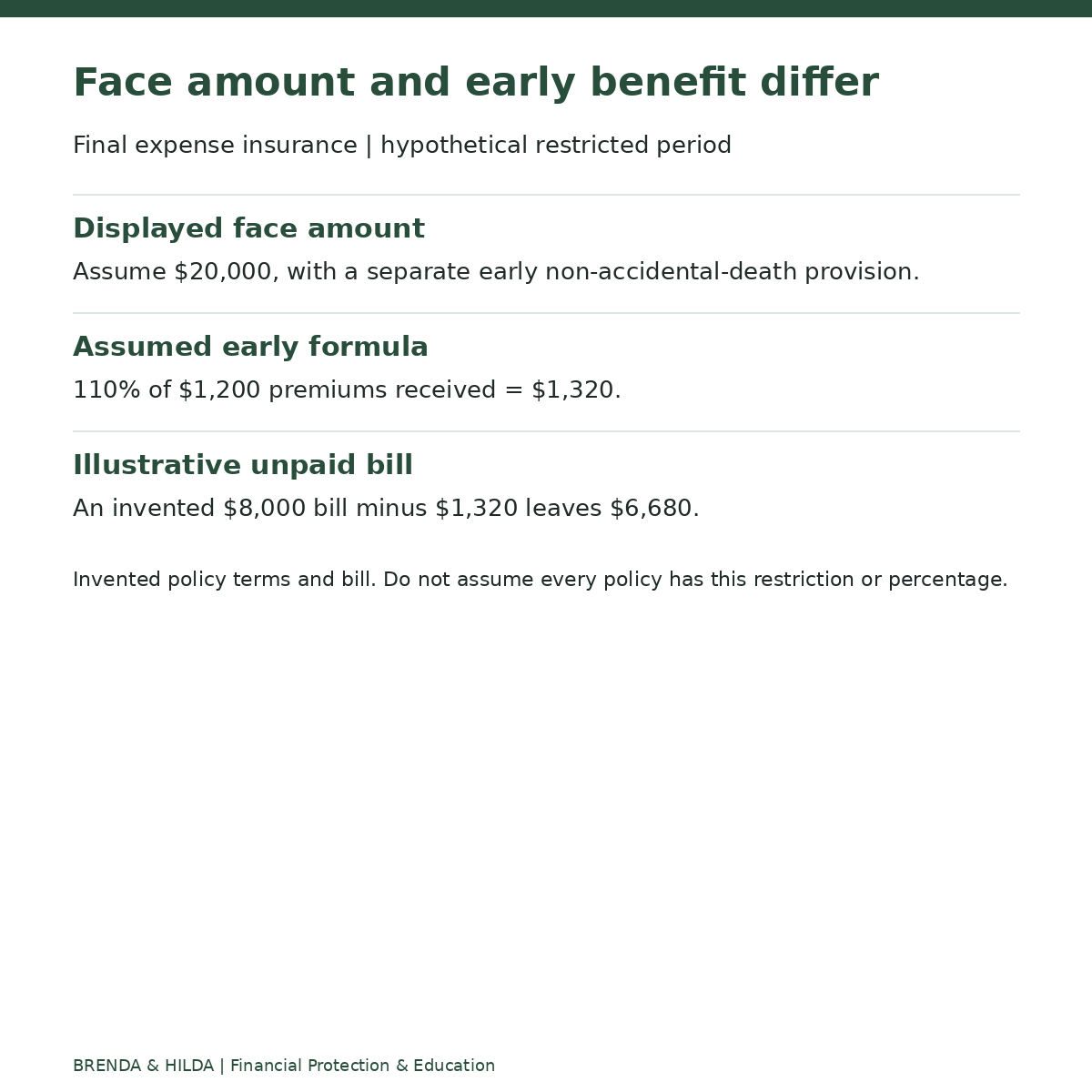
Hypothetical example: a policy shows a $20,000 face amount but has an assumed initial non-accidental-death provision paying 110% of premiums received. If $1,200 has been paid when a death occurs within that period, the assumed provision pays $1,320. It does not pay $20,000. The percentage and restriction are invented for this example; actual policy wording must establish both.
How much does final expense insurance cost over time?
A level final expense insurance premium is still an ongoing household expense. Establish when premiums end, whether they can change, what happens after a missed payment and whether cash surrender values exist. A policy that becomes unaffordable and lapses may leave the original expense unfunded.[1]
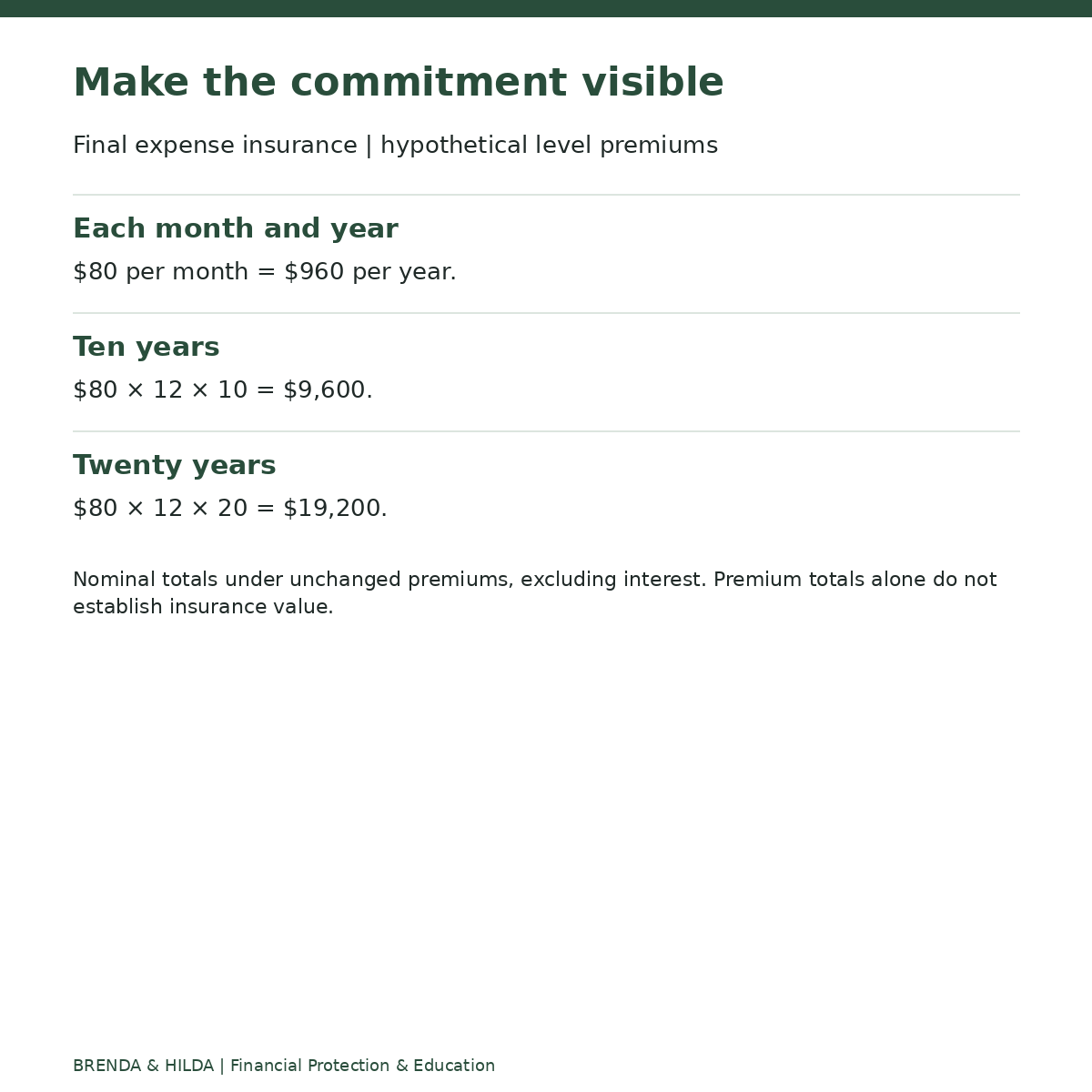
Hypothetical cost illustration: an assumed premium of $80 a month totals $960 a year, $9,600 over ten years and $19,200 over twenty years. These are nominal sums, excluding interest and changes; they are not market quotes. Insurance provides a benefit for a covered death during the insured period, so premium totals alone do not measure its value. They do make the long commitment visible.
A final expense insurance illustration should also show guaranteed surrender values, if any. Cancelling a policy does not ordinarily mean receiving all premiums back. Where a refund provision exists, its conditions need to be read separately.
Who receives a final expense insurance payment?
A named beneficiary generally receives the death benefit after a valid claim. If the estate is the beneficiary, the money enters a different administrative process. If a minor is named directly, additional arrangements may be necessary before someone can receive and manage the funds.[1]
Discuss beneficiary arrangements with an appropriate legal professional where needed. A policy description such as “for funeral costs” does not itself create a trust or guarantee that a particular invoice will be paid immediately. Ask what documents the insurer requires and how a claim is submitted; avoid relying on an unsupported promise of payment within a fixed number of days.
Can final expense insurance be used for anything?
Where it is an ordinary life policy paying an unrestricted death benefit to a named adult beneficiary, the label “final expense” does not itself require that person to spend the proceeds on a funeral. An assignment, trust or separate funeral arrangement can change who controls the money. The actual policy and beneficiary arrangement determine the answer.[1]
This matters when one relative is expected to pay an invoice but another receives the benefit. The intended purpose and the legal recipient need to be understood together; a marketing name cannot resolve that difference.
Review existing coverage before adding final expense insurance
An existing policy may have useful guarantees or may be close to the end of its premium-paying period. Replacing it can introduce new costs, underwriting and contractual restrictions. Get a written comparison before surrendering it.[1]
For a practical review, gather existing policy statements, any prepaid arrangement and an estimate of the expenses the family intends to fund. Separate costs that must be paid quickly from amounts that can be dealt with through the estate. That shows whether there is an unfunded need and who would need access to the money.
Beneficiaries and funeral arrangements need the local rules
Quebec: naming a married or civil-union spouse as beneficiary is generally presumed irrevocable unless the designation says otherwise. The AMF distinguishes that spouse from a de facto or common-law partner. Consent can therefore be needed to change a designation that someone assumed was freely changeable. Divorce and the dissolution of a civil union also have specific consequences. AMF: beneficiary designations and relationship changes.
Other provinces and territories: Alberta, British Columbia, Manitoba, New Brunswick, Newfoundland and Labrador, Nova Scotia, Ontario, Prince Edward Island, Saskatchewan, Northwest Territories, Nunavut and Yukon have their own insurance and estate laws. Establish whether the actual designation is revocable or irrevocable, whether there is an assignment and whether a minor is involved. Quebec’s marital presumption must not be presented as the rule for those jurisdictions. The FCAC directory of provincial and territorial regulators identifies the local authority.
If a child is the beneficiary, the age-of-majority distinction is 18 in Alberta, Manitoba, Ontario, Prince Edward Island, Quebec and Saskatchewan, and 19 in British Columbia, New Brunswick, Newfoundland and Labrador, Nova Scotia, Northwest Territories, Nunavut and Yukon. That age is not permission to assume a parent can automatically receive and spend the child’s benefit. Quebec has a tutorship system for a minor’s property; other jurisdictions have their own rules on trustees, guardians and payments to minors. Official age-of-majority table.
The funeral-cost and premium examples above are invented amounts. They do not estimate a provincial funeral price or a government funeral benefit. A prepaid arrangement, assistance program and insurance death benefit each have their own terms and administration.
A policy with cash values raises a separate question about what cancellation would return. The whole life explanation distinguishes guaranteed surrender values from projected additions.
How do you estimate a final expense insurance funding gap?
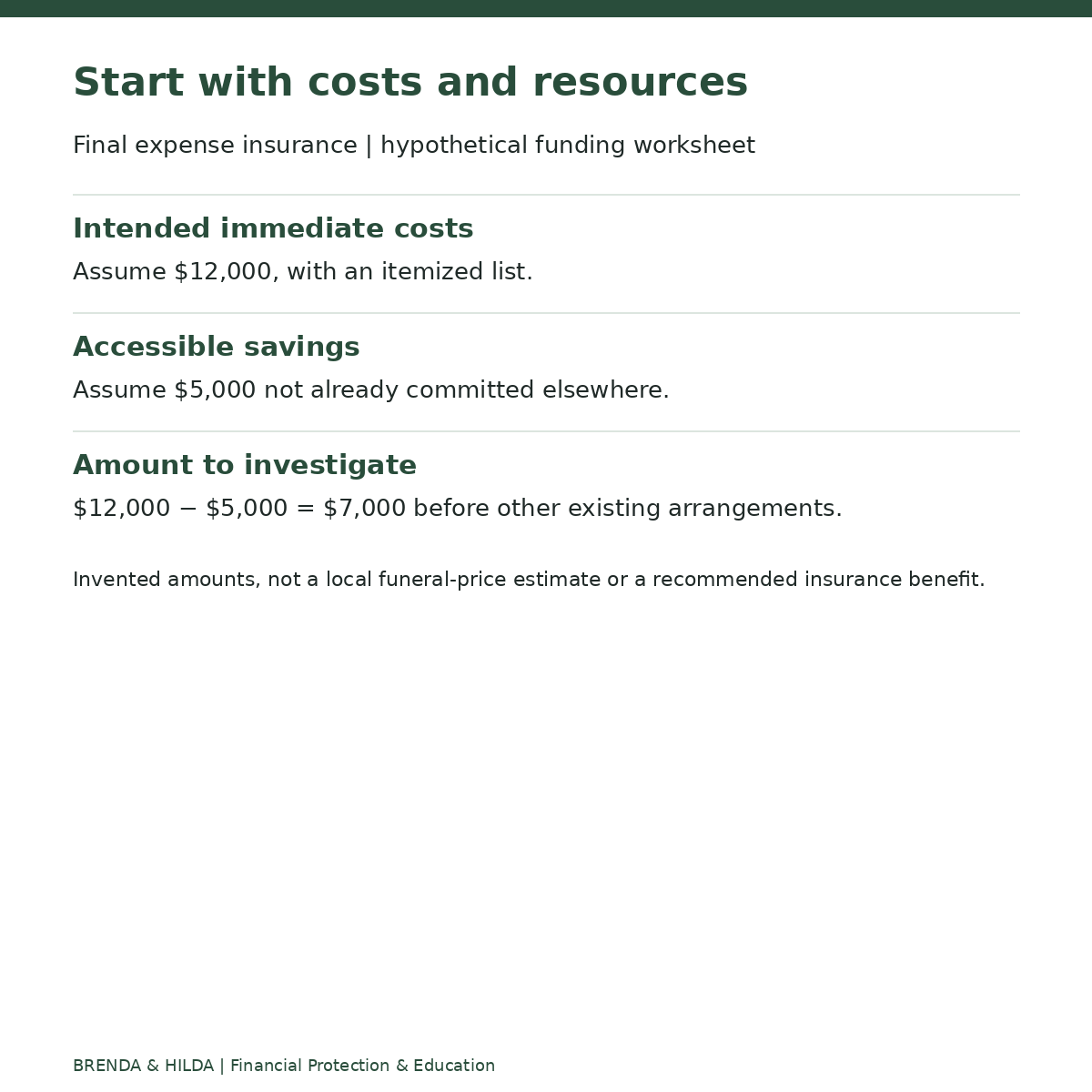
Use the family’s intended expenses and resources rather than starting with a round policy amount. Hypothetical example: assume the household lists $12,000 of immediate costs and identifies $5,000 of accessible savings that is not committed elsewhere. The arithmetic leaves $7,000 to investigate. That figure is not a coverage recommendation. An existing policy, prepaid arrangement, timing issue or different estimate could change it. Record what is included in the $12,000 so another family member can see whether the same expense has been counted twice.
What if the person receiving the benefit is not paying the invoice?
Map the intended payment route before treating final expense insurance as an immediate source of funds. Write down the policy owner, insured person, beneficiary and the relative who expects to organize the funeral. Those may be different people. Ask how an assignment or trust, if one exists, affects payment. A family conversation can clarify intentions, but it does not replace the policy designation or the local legal requirements. Keep contact details and document locations available without publishing identity documents or medical records.
How does a restricted early benefit change the calculation?
Return to the invented $20,000 policy example. With $1,200 of premiums received and an assumed provision paying 110%, the payment is $1,320. If the family separately assumes an $8,000 immediate bill, subtracting that payment leaves $6,680. This is arithmetic under invented terms, not a prediction about a real death claim or a funeral-price estimate. A final expense insurance comparison should show the benefit that would apply during any restricted period as well as the later face amount. Ask the insurer which dates, causes of death and premium amounts its actual clause uses.
What documents help compare final expense insurance fairly?
Obtain the issued or specimen contract, premium schedule, early-benefit provisions and any guaranteed cash-value table. Put existing policies and prepaid arrangements beside them. A quote that answers only the monthly premium leaves important questions open. Ask whether premiums are fixed, how long they are payable and what a cancellation would return at the dates relevant to the household. Record the answer and the contract page together. If a benefit or value is illustrated rather than guaranteed, identify it as such instead of adding it to the guaranteed column.
What should you check before replacing final expense insurance?
Compare what is already in force with the actual proposed terms. Identify any new health assessment, initial restriction, cost change or loss of an existing guarantee. Ask when the new coverage becomes effective and what evidence confirms that date. An application alone does not establish effective replacement coverage. Avoid making a cancellation decision from the monthly price alone. A written comparison gives the household something concrete to review with a licensed representative and, for beneficiary or estate questions, the appropriate legal professional.
What is a useful first conversation about final expense insurance?
Begin with the intended expenses, who would arrange payment and the resources already available. Mark uncertain prices, claim timing and access to funds as questions. Then gather the relevant contracts and ask for written answers. The result may be confirmation that existing arrangements already address part of the purpose, or it may identify an unresolved need. Neither outcome automatically establishes which product to buy. A personal recommendation requires a separate needs analysis that considers affordability and the household’s circumstances.
Source
[1] FCAC, Life insurance; FSRA, Policy types; AMF, Guaranteed issue life insurance. All premium and restricted-benefit calculations above use invented assumptions, not an insurer’s terms.
About your advisor
Brenda Nkwocha and Hilda Chukwu are licensed life insurance advisors in Ontario. Personal recommendations and quotes follow a separate needs analysis. This article provides general education, not personalized advice, a quote or a guarantee.
Choose a starting point that fits your situation.
Answer a few questions about your existing arrangements and what to check. A summary is not a needs analysis or a recommendation.