Whole life insurance: separate the guaranteed values from the illustration


A whole life insurance illustration can show a death benefit, cash values and projected additions decades into the future. Those columns do not all carry the same promise. The contract’s guaranteed figures need to be separated from values that depend on future dividends or other assumptions.[1]
Whole life is permanent life insurance intended to remain in force for the insured’s lifetime when its conditions are met. Its early premiums are generally higher than term premiums for comparable coverage. The pricing and reserve help support the insurance cost as the insured ages. That reserve is not a personal bank balance the owner can withdraw in full.[1]
What does whole life insurance guarantee?
Traditional whole life insurance commonly specifies a premium schedule, death benefit and minimum cash surrender values. The schedule may require premiums for life or for a stated payment period. Product variations exist, so establish exactly which amounts and dates are guaranteed.[1]
Participating whole life insurance can also pay policy dividends. These are not guaranteed. The insurer’s actual experience and dividend decisions affect them. A dividend interest scale is not the policy owner’s personal investment return, and an illustrated value is not automatically an amount the owner can withdraw.
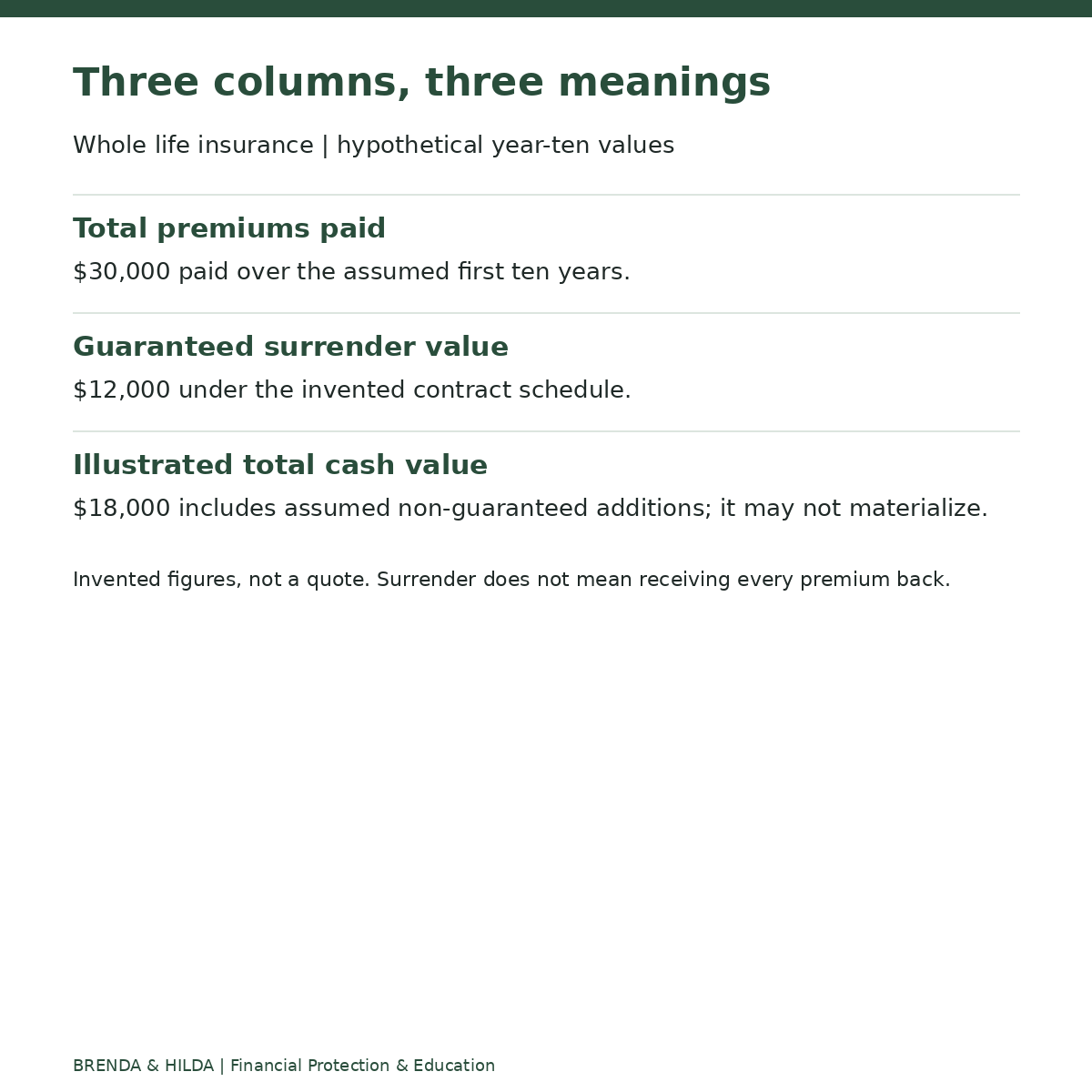
Hypothetical illustration: after ten years an owner has paid $30,000 in premiums. The assumed schedule shows a guaranteed cash surrender value of $12,000 and an illustrated total cash value of $18,000 that includes non-guaranteed additions. If the illustration’s assumptions do not occur, the $18,000 may not materialize. Surrendering does not entitle the owner to the $30,000 paid. These invented figures show how columns differ; they are not a quote or a forecast.
Can whole life insurance become paid up?
A contractual twenty-pay policy specifies a premium-paying period in its terms. An illustration suggesting that future dividends might cover premiums after twenty years relies on the dividends being sufficient. If they are lower, the owner may need to continue out-of-pocket payments.[1]
Ask for the guaranteed premium obligation, then a separate explanation of any projected premium offset. A description such as “you can stop paying later” should identify which of those arrangements is meant.
Can whole life insurance be cashed out?
A policy with a cash surrender value can generally be surrendered for the amount payable under its terms. Surrender ends the coverage; it does not refund every premium paid. Outstanding policy debt and tax consequences can change the net proceeds. A current surrender quote is more useful than a projection prepared when the policy began.[1]
Borrowing is a different transaction. It creates debt and interest, even if the loan is secured by the policy’s value. The choice between keeping, borrowing against or surrendering a policy requires the current figures and the consequences for the remaining insurance.
What changes when you access whole life insurance values?
Surrender ends the insurance and can create a taxable policy gain. A policy loan accrues interest and can reduce the amount ultimately payable or place the policy at risk if debt grows too large. Withdrawals and dividend transactions can also change values and tax results.[1]
A policy loan from the insurer and a bank loan secured by the policy are different transactions. Neither is a free withdrawal of investment profits. Ask how interest is calculated, what happens if it is unpaid and whether a transaction produces a taxable gain. Policy tax treatment requires the policy’s adjusted cost basis and the details of the transaction; a general promise of tax-free access is inadequate.
Some policies offer reduced paid-up insurance or another non-forfeiture option if premiums become unaffordable. That can preserve a smaller benefit using available value. It changes the arrangement and should be compared with keeping or surrendering the policy.[1]
Can you afford the whole life insurance premium?
A plan based on permanent coverage needs enough ongoing cash flow to keep that coverage. Record the guaranteed premium alongside housing, debt payments and emergency resources. Ask what happens after a missed payment in an early year when little surrender value has accumulated.
Bring both the guaranteed and illustrated schedules to a needs review. The discussion should establish the insurance purpose, the duration of that need and the tradeoff between premiums and other household priorities. Projected cash values cannot establish suitability by themselves.
Whole life values and beneficiary law answer different questions
The guaranteed premium and cash-value schedule come from the policy. The tax result of surrender or a policy loan also requires the policy records and applicable tax rules. Provincial residence does not make a non-guaranteed dividend guaranteed or turn a policy loan into free income.
Quebec: naming a married or civil-union spouse as beneficiary is generally presumed irrevocable unless the designation says otherwise. The AMF distinguishes that spouse from a de facto or common-law partner. Consent can therefore be needed to change a designation that someone assumed was freely changeable. Divorce and the dissolution of a civil union also have specific consequences. AMF: beneficiary designations and relationship changes.
Other provinces and territories: Alberta, British Columbia, Manitoba, New Brunswick, Newfoundland and Labrador, Nova Scotia, Ontario, Prince Edward Island, Saskatchewan, Northwest Territories, Nunavut and Yukon have their own insurance and estate laws. Establish whether the actual designation is revocable or irrevocable, whether there is an assignment and whether a minor is involved. Quebec’s marital presumption must not be presented as the rule for those jurisdictions. The FCAC directory of provincial and territorial regulators identifies the local authority.
For a child beneficiary, Quebec’s minor-property tutorship rules differ from the trustee and guardianship arrangements that may apply elsewhere. The family’s intended use of cash and the person legally entitled to receive it should be documented separately. A contract-value illustration cannot answer those legal questions.
The cash-value schedule is only part of the comparison. The term and whole life article examines the length of the financial obligation before comparing premiums.
How do you read a whole life insurance illustration without mixing columns?
Use one date and one transaction at a time. In the invented ten-year example above, the $30,000 premium total, $12,000 guaranteed surrender value and $18,000 illustrated total answer different questions. Write the reason for each figure beside it: money paid, guaranteed value under the assumed schedule, or a projection that depends on assumptions. Ask whether the illustrated death benefit includes additions that are not guaranteed. Do not add the surrender value to the death benefit unless the actual contract says those amounts are payable together.
What if the whole life insurance projection changes?
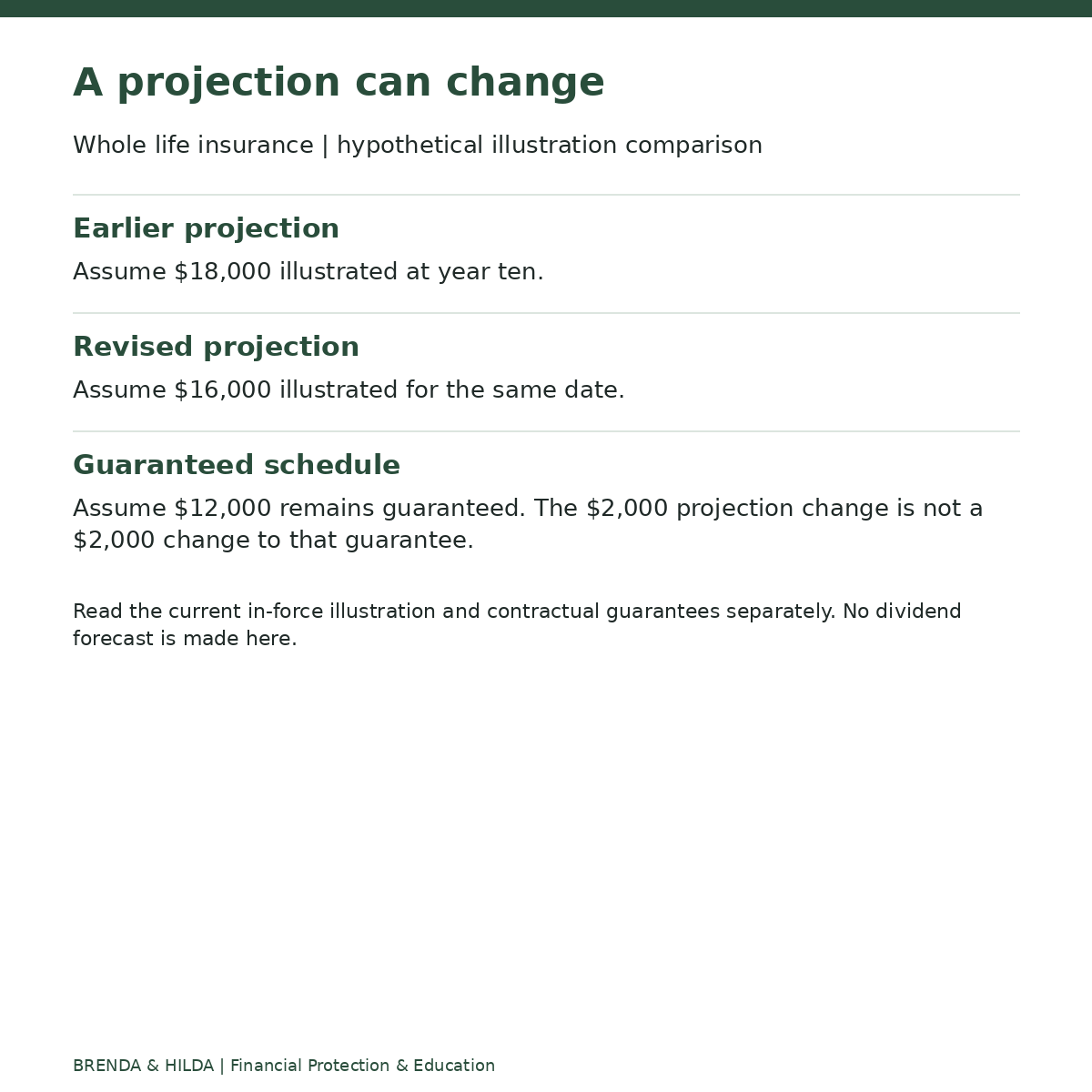
Ask for a current in-force illustration and compare it with the guaranteed schedule, using the same policy date. For an invented comparison, suppose the old projection showed $18,000 at year ten and a revised projection shows $16,000 while the assumed guaranteed value remains $12,000. The change is $2,000 in the projection, not proof that the guaranteed value has fallen by that amount. This example illustrates record keeping, not a forecast about dividends. Ask the insurer to identify which assumptions changed and how any planned use of policy values would be affected.
How can you test whole life insurance premiums against a budget?
Start with the contractual payment obligation. Suppose an invented policy requires $250 a month and the household has a $400 monthly surplus before that payment. The assumed remaining surplus is $150. Then consider the family’s actual obligations and the possibility of a lower income or higher expenses. The arithmetic does not establish affordability or recommend the policy. It simply makes the tradeoff visible. Check whether the quoted premium includes all selected riders and whether the stated payment period is guaranteed or depends on future policy performance.

What should you ask for before accessing whole life insurance values?
Request a current written quote for the specific transaction being considered. Identify the gross amount, any debt or charges deducted, the net payment and the remaining insurance. Ask what tax information the insurer will provide and what a qualified tax professional needs to review. Keep a policy loan, a withdrawal, a surrender and an outside collateral loan on separate lines. A calculation prepared for one transaction cannot establish the consequences of another. The intended use of the cash belongs beside the cost and the effect on the coverage.
What records belong in a whole life insurance review?
Bring the policy and amendments, latest statement, guaranteed-value schedule, original illustration and any updated illustration. Include details of policy debt and the premium-payment arrangement. If the policy is assigned, identify the assignment for the review rather than assuming all transactions are freely available. A clear comparison uses the same date and assumptions for each option. Mark an unexplained value as a question and ask for its source. This allows the household to discuss a concrete set of figures instead of relying on a remembered sales explanation.
Can an existing whole life insurance policy be reviewed without replacing it?
Yes. A review can begin by establishing the current purpose, guaranteed obligations and available options in the existing contract. It does not require an application for new insurance. Ask the licensed representative to explain what keeping the policy would involve before comparing a change. If replacement is proposed, obtain the written differences, new underwriting requirements, effective date and any lost guarantees or costs. A lower initial premium or a larger illustrated value alone cannot establish that replacement suits the household. Personal recommendations require a separate needs analysis.
Source
[1] FSRA, Policy types; AMF, Participating and non-participating whole life insurance; AMF, Accessing cash surrender value.
About your advisor
Brenda Nkwocha and Hilda Chukwu are licensed life insurance advisors in Ontario. Personal recommendations and quotes follow a separate needs analysis. This article provides general education, not personalized advice, a quote or a guarantee.
Choose a starting point that fits your situation.
Answer a few questions about your existing arrangements and what to check. A summary is not a needs analysis or a recommendation.