Five places disability income may come from, and why the totals may shrink


A list of possible disability income sources can make a household look better protected than it is. Sick leave may end before another plan starts. A government award can reduce an insurer’s payment. Emergency savings can cover a wait, but every dollar spent reduces what remains.
The useful exercise is to put the sources on a timeline and apply each source’s rules. FCAC explains that benefits from one plan may reduce payments from another. A stated benefit amount should not be added to another without checking coordination rules.[1]
1. Disability income from paid sick leave and salary continuance
An employer may continue full or partial pay for an initial absence. The number of days, eligibility and evidence requirements depend on the arrangement. Identify whether this is a bank of paid days, an employer-funded disability program or insured coverage. These can appear together in a benefit booklet without being the same source of money.
Ask what happens when the paid days run out. A household needs the date and expected amount of the next payment, including any period with no income. The employer’s leave entitlement and the benefit administrator’s claim decision can also be separate matters.
2. Workplace disability income
Workplace plans can replace part of covered earnings after a waiting period, subject to caps and continuing eligibility. Their definition of disability, tax treatment and offset provisions affect the usable amount. Long-term coverage may apply a different occupational test after an initial period.[1]
Leaving employment can change this protection. Check continuation and conversion provisions where available instead of treating the workplace benefit as a permanent personal asset.
3. Individual disability income insurance
An individually owned contract has its own benefit, elimination period and definition. It may be designed to supplement other coverage, but issue limits and coordination provisions still need review. Two policy schedules cannot safely be added without reading those terms.[1]
For a self-employed person, distinguish personal income replacement from business overhead expense insurance. Rent for the business premises and groceries for the household are different obligations, potentially addressed by different coverage.
4. Government disability income programs
EI sickness benefits can provide up to 26 weeks for eligible claimants, generally at 55% of insurable earnings up to the annual maximum. CPP disability has a separate contribution and eligibility test, including a severe and prolonged disability. Approval for one program does not establish eligibility for the other. Workplace injury compensation may also be relevant for an eligible work-related condition.[2][3]
Private plans can deduct certain government benefits. Ask about retroactive awards as well as ongoing payments: a later award may create an amount owing to an insurer that already paid for the same months.[1]
5. Savings used alongside disability income
Savings can cover an initial delay or costs above benefits. They are a finite resource, not insurance income. Borrowing creates a repayment obligation and should be recorded separately from savings. An RRSP withdrawal may also create tax that an ordinary TFSA withdrawal would not.[1]
Can you receive disability income from more than one source?
It may be possible, but that does not mean adding every stated benefit together. Each program or contract applies its own eligibility rules, and a private plan may deduct income received from another source. An award from CPP disability can therefore change the insurer’s payment without increasing total income by the same amount.[1][3]
Start dates matter as much as the totals. An employee may use sick leave first, wait for another benefit and then receive a retroactive award. The long-term disability explanation shows a numerical offset example; actual coordination comes from the plan wording.
Put disability income sources through one hypothetical budget
Hypothetical example: essential spending is $4,200 a month. An assumed LTD entitlement is $3,000 before offsets and is tax-free in this example. A qualifying $800 government payment is deducted dollar for dollar under the assumed plan, leaving $2,200 from the insurer and $800 from government. Total income is $3,000, not $3,800. The monthly spending shortfall is $1,200.

If $7,200 of savings remains when these payments start, it covers six months of that $1,200 shortfall, assuming no interest or expense changes. Any savings spent during the waiting period must be subtracted first. Actual taxes, offsets and eligibility could change every figure.
For a disability income review, bring the benefit booklets, current policy schedules and a monthly expense list to a review. Mark the start date, end date and offset rules for each payment. Leave an unverified benefit blank instead of treating it as assured income.
Which public pension applies in each province and territory?
| Provinces and territories | Public pension disability program |
|---|---|
| Alberta, British Columbia, Manitoba, New Brunswick, Newfoundland and Labrador, Nova Scotia, Ontario, Prince Edward Island, Saskatchewan, Northwest Territories, Nunavut and Yukon | CPP disability, administered by Service Canada |
| Quebec | QPP disability, administered by Retraite Québec |
These are public pension routes, not descriptions of every private policy. Contribution history matters for someone who has worked both in Quebec and elsewhere. Eligibility under an employer’s plan, CPP or QPP must be considered separately.
Retraite Québec’s explanation identifies a particularly important Quebec interaction: a private insurer may reduce its payment when QPP disability, and in certain circumstances QPP retirement, is paid. A retroactive award can create a repayment obligation. QPP also does not cover temporary inability to work. The sample budget cannot therefore be read as a prediction of a Quebec claimant’s public entitlement. QPP eligibility and integration rules.
EI sickness is federal, including for eligible Quebec workers; the Quebec Parental Insurance Plan is a separate parental-benefit program. Provincial and territorial workers’ compensation and employment leave must also be kept separate from private insurance. For the workplace authority in any of the 13 jurisdictions, use the Government of Canada’s employment-standards directory. Revenu Québec explains Quebec wage-loss withholding rules; other taxpayers also need the combined federal and provincial or territorial tax result.
Job-protected leave and disability payments answer different questions
The province or territory’s leave entitlement determines protected time away from work; a disability plan determines whether income is payable. Paid sick days, unpaid medical leave and private benefits may follow different eligibility and evidence rules. The province-by-province sick-leave comparison covers all 13 provinces and territories, with a separate federal-workplace row. Use the employment jurisdiction rather than assuming the rule follows the employee’s home address.
How do you build a disability income timeline?
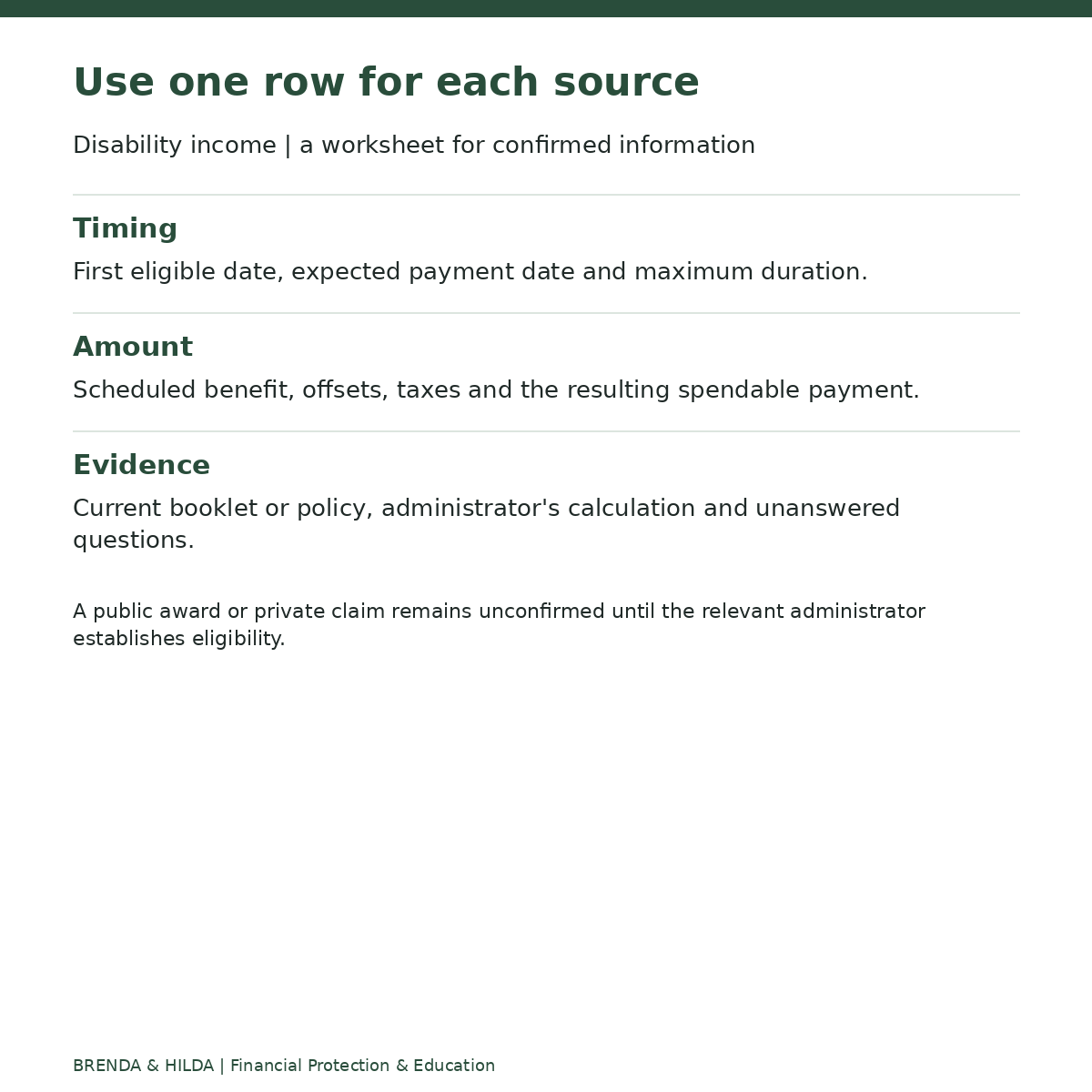
Use a separate row for each source and columns for the first eligible date, expected payment date, maximum duration and confirmation status. Write unknown where a date has not been established. For an invented timeline, sick pay might cover days 1 through 5 while a different benefit has a later start. That leaves a question about the intervening days; it does not establish that the next program will cover them. Put the bills due during that interval beside the available cash rather than assuming an eventual retroactive payment solves every due date.
Why can disability income look larger on paper?
A benefit schedule can show amounts before offsets, tax and payment limits. Consider the example above: adding $3,000 and $800 produces $3,800 on a worksheet, but the assumed contract reduces the insurer payment by that $800. The household receives $3,000 in total under those assumptions. Use columns for the scheduled entitlement, adjustments and actual payment to keep the arithmetic visible. Ask the administrator to explain a deduction that you cannot reconcile. The same worksheet can hold a different formula without pretending all plans apply this example.
How long would savings fill a disability income shortfall?
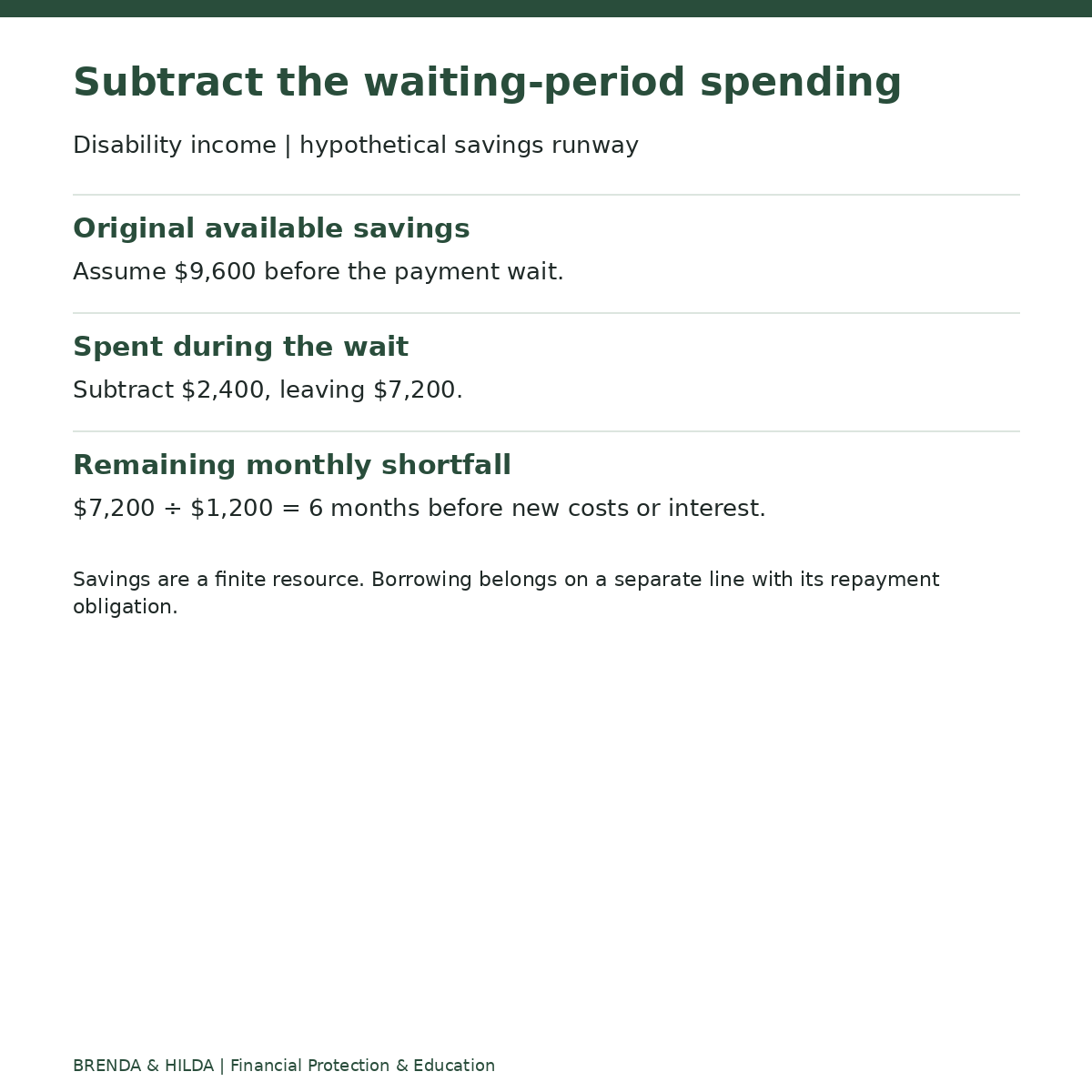
Calculate from the savings actually available when the shortfall begins. Suppose the example household originally had $9,600 but spent $2,400 during the wait for benefits. That leaves $7,200, which covers six months of the assumed $1,200 monthly gap. Using the original savings balance would overstate the remaining runway by two months. Set aside money already committed to another bill before calculating the balance available for this purpose. This simplified arithmetic ignores new expenses and interest and does not establish a suitable emergency-fund target.
What should self-employed households separate?
Keep household disability income and business expenses on different parts of the worksheet. An invented household might need $3,500 for its own bills while the business has $1,800 of ongoing premises and service costs. Those amounts identify two obligations; they do not mean a single disability policy covers both. Record who owns each contract, who receives the benefit and which expenses the wording addresses. Also ask which business costs could actually stop or change during an absence. A needs analysis can then use the verified figures rather than one blended estimate.
Who should confirm the disability income figures?
The employer or benefit administrator can explain the workplace arrangement. The insurer can identify the contract’s calculation and required claim information. Service Canada or Retraite Québec administers the relevant public pension route. Payroll or a qualified tax professional can help establish the treatment of the actual payments. Give each unanswered question to the appropriate source and record the response date. A single advisor’s general explanation does not replace a benefit decision, payroll history or a government eligibility determination.
What is a useful result from a disability income review?
A useful result is a dated worksheet showing confirmed resources, assumptions and unanswered questions together. Keep the current benefit documents alongside it so later changes can be traced. Add a note when a job, contract, household cost or public award changes. The goal is to understand the existing arrangements before making decisions about coverage. A remaining budget gap is a discussion point, not an automatic recommendation to purchase a product. Personal advice requires the household’s circumstances and the terms of any proposed coverage.
Sources
[1] FCAC, Disability insurance; AMF, Disability insurance, including business overhead expenses; CRA, RRSP withdrawal tax treatment; CRA, TFSA withdrawals.
[2] Service Canada, EI sickness benefit amounts.
[3] Service Canada, CPP disability benefits. Program descriptions checked October 14, 2026.
About your advisor
Brenda Nkwocha and Hilda Chukwu are licensed life insurance advisors in Ontario. Personal recommendations and quotes follow a separate needs analysis. This article provides general education, not personalized advice, a quote or a guarantee.
Choose a starting point that fits your situation.
Answer a few questions about your existing arrangements and what to check. A summary is not a needs analysis or a recommendation.