A segregated fund guarantee has a date, a percentage and a calculation


A segregated fund guarantee is an insurance promise attached to a market-based investment. The phrase “your money is guaranteed” leaves three questions unanswered: how much, when and after which adjustments? With a segregated fund guarantee, market value and guarantee value can be different numbers for years.[1]
The market value is what the investments are worth now. A maturity guarantee sets a minimum benefit at the applicable maturity date. A death-benefit guarantee sets a minimum payable following the annuitant’s death. Neither turns every withdrawal into a guaranteed payment.
Are segregated funds guaranteed against every loss?
Contracts commonly describe guarantees as 75/75, 75/100 or 100/100. The two percentages describe maturity and death-benefit protection, respectively. The guarantee base, eligible deposits, ages and dates come from the actual contract.[1]
Hypothetical example: a contract has a $60,000 eligible deposit, a 75% maturity guarantee and a 100% death-benefit guarantee. Assume no withdrawals, later deposits or resets. Its maturity floor is $45,000; its death-benefit floor is $60,000. At a hypothetical market value of $38,000, the relevant event determines the outcome. At the applicable maturity date, a $7,000 top-up produces $45,000. On the annuitant’s death while the stated death guarantee applies, a $22,000 top-up produces $60,000. These are alternative scenarios, not payments added together.
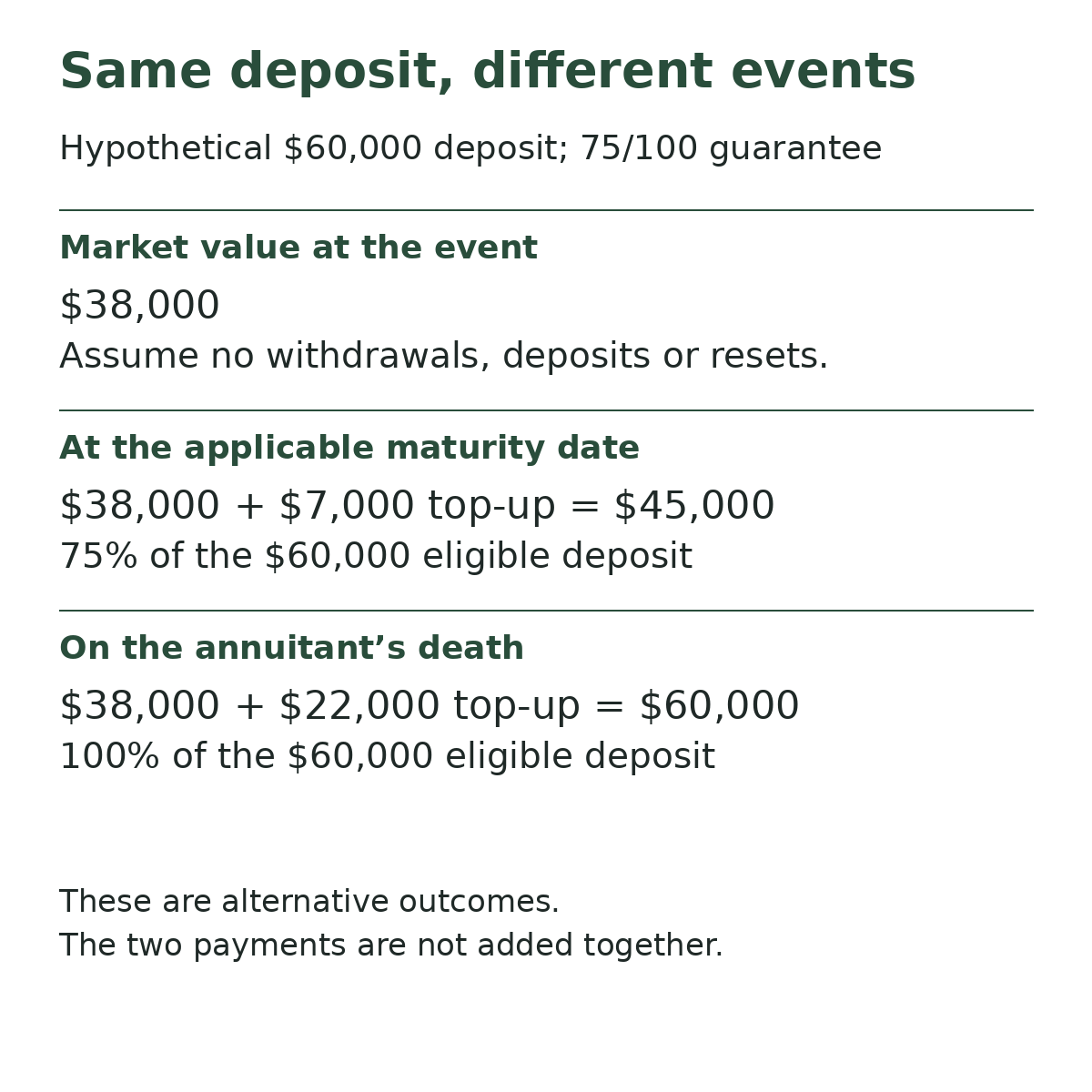
If the market value at the applicable event is higher than the guarantee, the market value ordinarily determines the benefit. The insurer does not pay the market value plus the full guarantee on top of it.[1]
Can you withdraw from segregated funds before maturity?
Generally, yes. A maturity-guarantee date does not necessarily lock away the investment. But an early redemption is normally based on market value, with any applicable charges, rather than a top-up to the maturity guarantee. A partial withdrawal can also change the guarantees left in the contract. Access to the money and protection against a loss are separate questions.[1]
How does a withdrawal change a segregated fund guarantee?
A partial withdrawal can also change the remaining segregated fund guarantee. The effect depends on the contract’s calculation, especially after a market decline. The following example assumes a proportional-reduction clause; it is not a rule for every contract.
Hypothetical example using an assumed proportional-reduction provision: the guarantee base is $60,000 and current market value is $48,000. A $12,000 withdrawal removes 25% of the market value. The guarantee base falls by 25%, from $60,000 to $45,000. A 75% maturity guarantee then equals $33,750. Remaining market value immediately after the withdrawal is $36,000, before any further movement or charges.
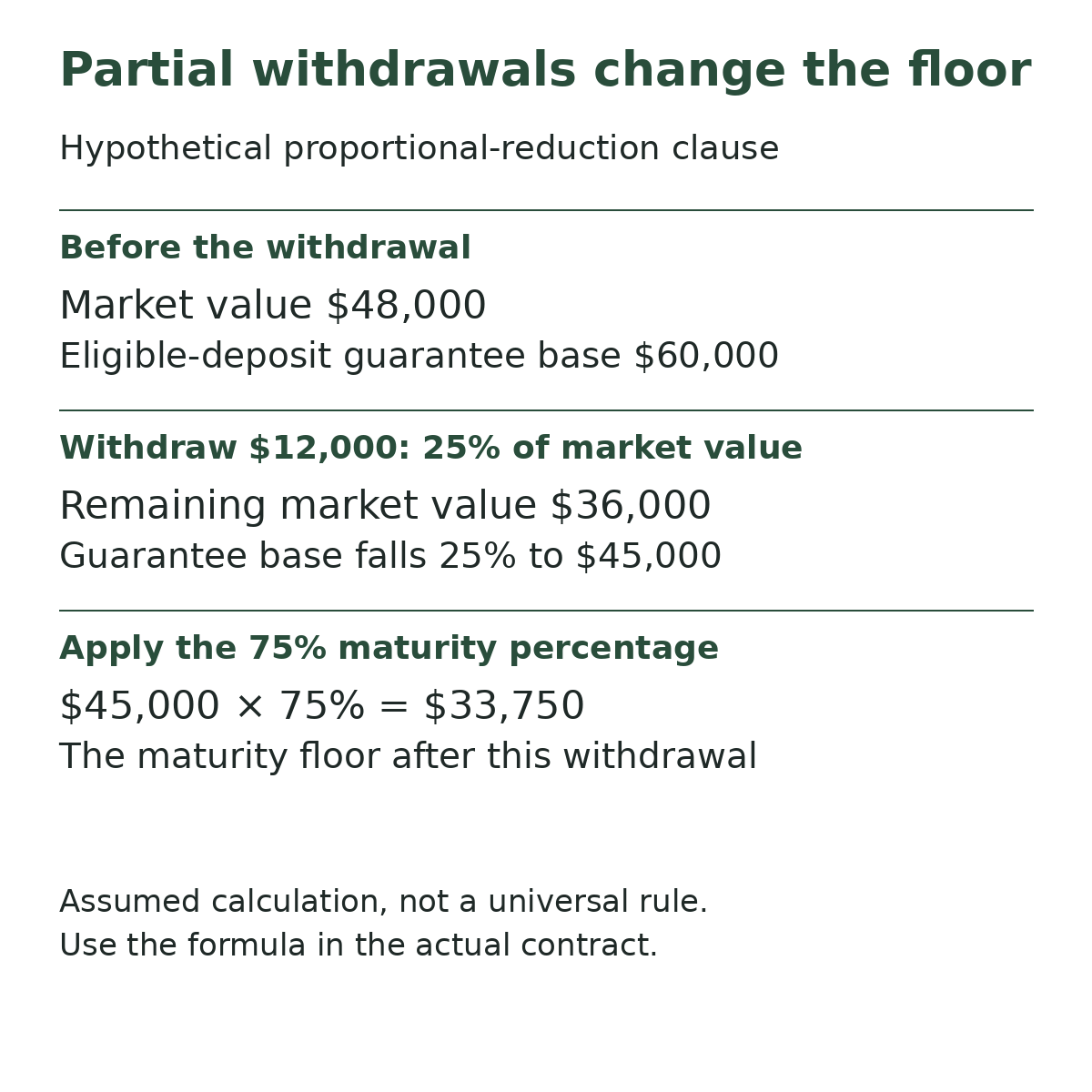
This example does not establish the segregated fund guarantee formula in your contract. Some provisions and benefit types use different calculations. Request an illustration showing the guarantee immediately before and after the withdrawal you are considering. A balance statement alone may not show the effect clearly.
A reset can move the date as well as the amount
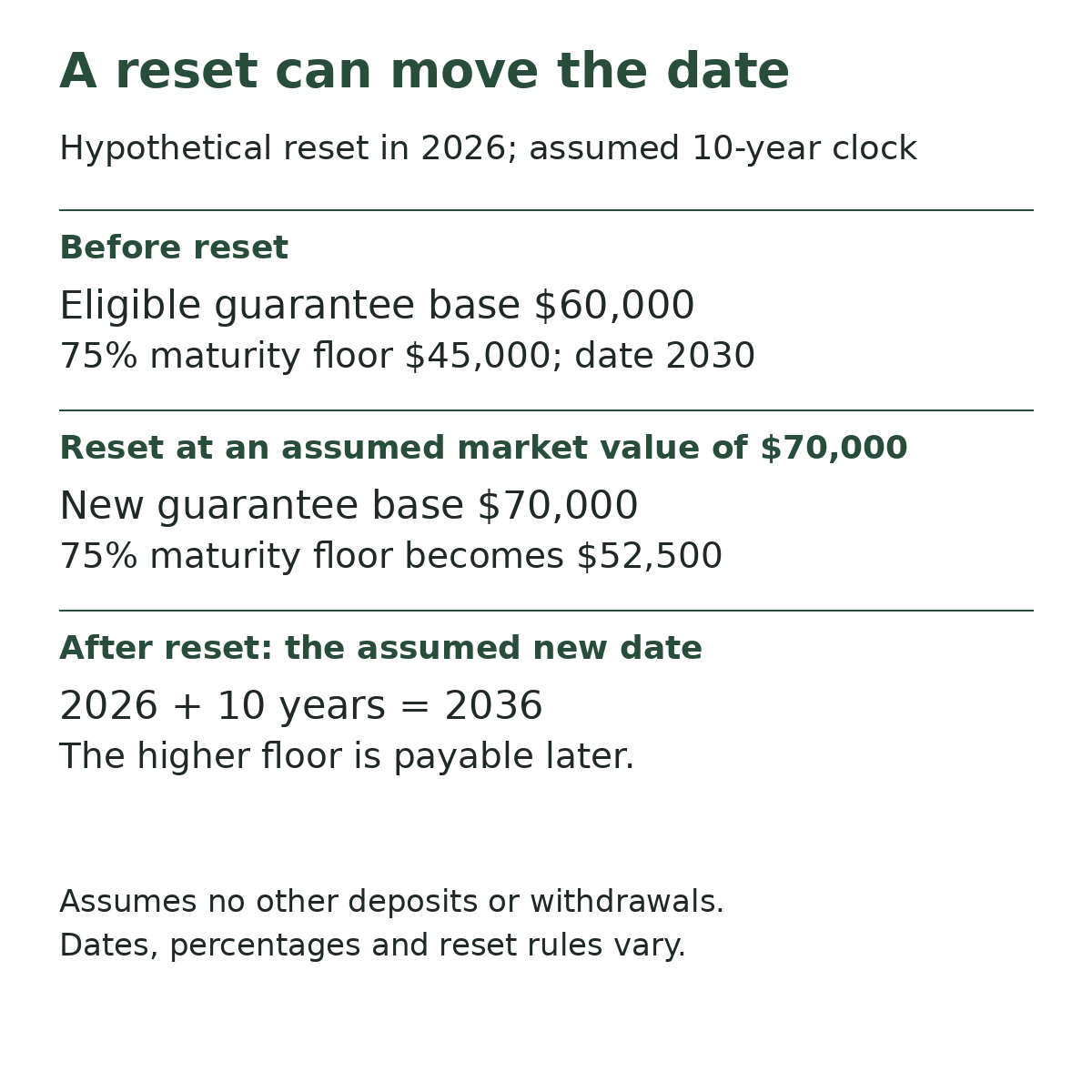
A reset of a segregated fund guarantee can allow a higher market value to become a new guarantee base, subject to contract limits. That feature is called a reset. It can also restart or extend the period before a maturity guarantee becomes payable. Frequency, maximum age and which guarantee can be reset vary.[1]
For someone planning to use the money soon, extending the guarantee date can be a substantial tradeoff. An increase in the recorded guarantee does not make that amount available for an immediate cash withdrawal.
Check whether later deposits have their own maturity dates. Also establish whether the contract matures after a set period or at an advanced age of the annuitant. A ten-year illustration should not be taken as evidence that every contract’s guarantee is payable after ten years.
Hypothetical reset example: assume a contract’s eligible guarantee base is $60,000, its maturity floor is 75% of that amount ($45,000), and its maturity date is 2030. Assume the particular contract allows a reset in 2026 to a $70,000 market value and restarts a ten-year maturity period. The new floor would be $52,500, but the date would move to 2036. There are no other deposits or withdrawals in this example. These are assumed contract terms, not a reset rule for all segregated funds.
Ask for three current figures
Request today’s market value, today’s maturity-guarantee amount and today’s death-benefit-guarantee amount. Beside each guarantee, record its date or triggering event. If you are considering a withdrawal or reset, obtain the same figures after the proposed transaction.
Keep the contract and its amendments with that explanation. They establish the insurer’s promise; an informal description of “capital protection” cannot replace them.
Does a guarantee mean a positive investment return?
No. A segregated fund guarantee can set a minimum benefit without promising a profit. A 75% maturity floor on an unchanged eligible deposit can still leave a loss of 25% at that date. Even a 100% nominal guarantee does not, by itself, promise interest or an increase in purchasing power.
Separate the guaranteed dollar amount from a return projection. The contract establishes which benefit is guaranteed; future market growth is another matter. Ask whether any quoted future value is contractual or illustrated, and which fees and transactions are assumed. A segregated fund guarantee should be read as the particular promise in the contract, rather than a general description of an investment as safe. The AMF’s explanation separates market fluctuation, guarantees and inflation protection.
Is the guarantee paid on top of the market value?
The earlier hypothetical case starts with a $60,000 eligible deposit and a $45,000 maturity floor. If the market value at maturity were $70,000, the payment under the assumed greater-of provision would be $70,000, rather than $115,000. The $45,000 floor is not an extra payment added to the investment value.
At the earlier $38,000 market value, the maturity top-up was $7,000 because $45,000 minus $38,000 equals $7,000. These calculations illustrate the same segregated fund guarantee at different market values. They do not forecast a return or establish an actual insurer’s calculation. Look for the clause that defines the benefit, then compare the market value with the applicable guarantee at the actual triggering event.
Is an insurance guarantee the same as deposit insurance?
No. A segregated fund guarantee is an obligation under an insurance contract. Deposit insurance addresses another type of arrangement and another risk. CDIC describes its protection as covering eligible deposits at member institutions if an institution fails. It also lists mutual funds, stocks, bonds and ETFs as products that are not eligible.
Holding an investment inside an RRSP or TFSA does not turn every product into an insured deposit. Equally, an insurer’s guarantee does not establish CDIC coverage. Identify the product, the institution and the protection being discussed before comparing the two. Read CDIC’s eligible-deposit explanation. A market-value decline and an institution’s financial failure should not be treated as the same event.
What if the insurer cannot meet its obligations?
The insurer’s ability to honour the contract is a separate consideration from the segregated fund guarantee formula. Do not assume that a guarantee percentage tells you everything about protection if an insurer becomes insolvent. Confirm which insurer is responsible and ask what protection applies to the particular benefit and ownership arrangement.
FSRA identifies Assuris as the organization that protects Canadian policyholders when their life insurance company becomes insolvent. That description does not establish full reimbursement of every investment balance or the terms applicable to a specific contract. Use FSRA’s official consumer information as a starting point, and obtain the current explanation for the actual insurer and benefit. An Ontario licensing check also does not substitute for the appropriate regulator elsewhere.
Which documents help explain today’s guarantee?
Keep the contract, amendments, current guarantee statement, Fund Facts and transaction history together. The contract describes the promise; the transaction history helps explain how its current base was reached. A deposit, withdrawal or reset can make an old illustration a poor description of today’s segregated fund guarantee.
Ask the insurer to show the starting base, each adjustment, the current percentage and the applicable date or event. Mark figures that are unknown rather than filling them with estimates. If you have several deposits, ask whether they share one maturity date or follow separate schedules. If a reset has occurred, keep the confirmation showing what changed. A single account-balance figure cannot answer all of these questions.
What should you check before asking for a reset?
Compare the segregated fund guarantee before the proposed reset with the guarantee after it. Include both the amount and the date. Ask whether the maturity guarantee, death benefit or both change, and whether an age restriction, added cost or new waiting period applies. A change to one benefit does not establish that every benefit changed in the same way.
Record the purpose and timing for the money beside that explanation. A larger segregated fund guarantee payable later may not answer a need for money sooner. This is a question for a separate suitability review using the actual contract and your circumstances, rather than a conclusion a generic example can make. The AMF’s reset example shows why the date needs attention alongside the amount.
Do segregated fund guarantees change from province to province?
A 75% or 100% segregated fund guarantee is a contractual feature, not a percentage automatically assigned by a province. The actual contract identifies eligible deposits, the annuitant, the relevant date and adjustments. Two contracts sold in the same province can have different guarantee provisions. The hypothetical calculations above therefore must not be treated as a schedule of provincial benefits.
Across Alberta, British Columbia, Manitoba, New Brunswick, Newfoundland and Labrador, Nova Scotia, Ontario, Prince Edward Island, Quebec, Saskatchewan, Northwest Territories, Nunavut and Yukon, the starting documents are the contract, its amendments, Fund Facts and current guarantee statement. Distribution and consumer-protection rules remain jurisdiction-specific. The CCIR/CISRO guidance explains what guarantee information should be disclosed and recognizes that local laws continue to apply.
An Ontario sales-charge rule does not describe all provincial legislation. The segregated-fund and mutual-fund comparison separates the Ontario, Quebec and British Columbia measures from the regulators’ national position. This distinction matters when reviewing an older contract or a proposed replacement.
Source
[1] AMF, Segregated funds. Numerical examples are original hypothetical calculations using explicitly assumed contract terms; they do not establish the withdrawal formula or guarantees of a particular contract.
About your advisor
Brenda Nkwocha and Hilda Chukwu are licensed life insurance advisors in Ontario. Personal recommendations and quotes follow a separate needs analysis. This article provides general education, not personalized advice, a quote or a guarantee.
Choose a starting point that fits your situation.
Answer a few questions about your existing arrangements and what to check. A summary is not a needs analysis or a recommendation.