Mortgage life insurance: who gets paid, and what happens when you move?


Mortgage life insurance often comes up while arranging a home loan. The mortgage payment can bring the household’s wider need for protection into focus. Yet paying off the loan is only one possible need after a death. The surviving household may also have rent for a relative, child-care costs or income to replace. The arrangement chosen determines who receives the insurance money and how it can be used.
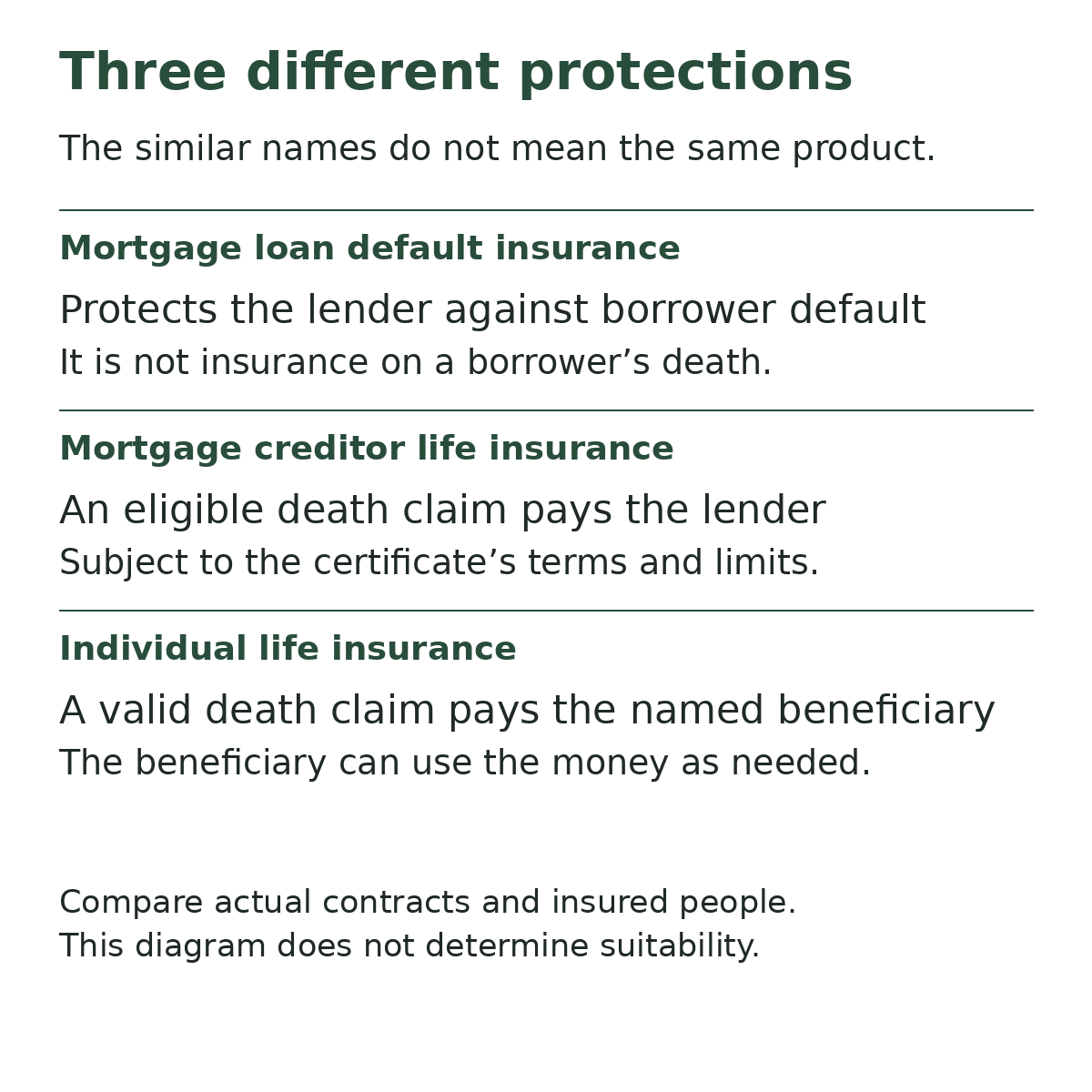
Mortgage creditor life insurance generally pays an eligible insured mortgage balance to the lender. An individual life insurance policy generally pays its death benefit to the designated beneficiary, who can use the money according to their needs. The products can overlap in purpose while giving the household different options.[1][2]
Is mortgage life insurance mandatory in Canada?
No. FCAC identifies mortgage life insurance as optional; buying it is not required for mortgage approval. This differs from mortgage loan default insurance, which protects the lender and may be required for a purchase with a smaller down payment. The similar names can make two separate decisions sound like one.[2]
Mortgage default insurance is a different product
The mortgage loan insurance associated with a small down payment protects the lender against borrower default. Optional mortgage life insurance responds to an insured death under its terms. One does not replace the other. FCAC distinguishes optional mortgage insurance from mortgage loan insurance required for many purchases with a down payment below 20%.[2]
Follow a hypothetical payment
Hypothetical example: a household starts with a $500,000 mortgage. Years later, the balance is $360,000 when an insured borrower dies. Assume a creditor policy covers that balance and a valid claim pays it to the lender. The mortgage is cleared, but that payment does not create an extra cash fund for child care or groceries.
In a separate hypothetical arrangement, a $500,000 level individual life policy pays a valid claim to a named adult beneficiary. If the beneficiary uses $360,000 to discharge the mortgage, $140,000 remains for other purposes. They might instead keep making mortgage payments and retain more liquidity. This comparison assumes the stated benefits, no relevant reductions or policy debt, and valid claims. It does not compare premiums or establish which arrangement suits that family.

What happens to mortgage life insurance as the balance falls?
Mortgage life insurance often follows the outstanding debt, subject to a maximum. An individual level policy can maintain a stated death benefit while the loan balance falls. Neither fact establishes a universal price advantage. Premiums depend on the product, insured people, ages, health, coverage and renewal provisions.[1][2]
Obtain both written costs for the same people and compare them over the intended period. Check whether the price changes and whether joint coverage ends after the first death. A cheap initial payment can tell a different story from the renewal schedule.
Does mortgage life insurance continue after refinancing?
Creditor coverage may depend on the particular loan or lender. Moving, refinancing or changing lenders can end coverage or require a new application, depending on its terms. Individual coverage is generally separate from the mortgage, although an assignment to a lender can affect the lender’s rights.[1][2]
Underwriting also deserves a precise answer. Ask which health questions must be answered now, which evidence the insurer will examine at claim time and what exclusions apply. It is misleading to assume that every creditor product postpones all underwriting or that every individual application requires a medical examination.
Compare the full household need
Make an inventory of existing life coverage, its beneficiary, expiry date and whether it continues after a job change. Then identify the costs the survivor would face beyond the mortgage. Include the economic value of unpaid caregiving; the absence of a salary does not make those services costless to replace.[1]
Before cancelling existing coverage, review replacement risks and the effective date of any new policy. New insurance may have different exclusions and contestability provisions. The next useful document is a written comparison of the actual contracts, followed by a needs analysis of the household that would rely on them.

Can you cancel mortgage life insurance?
Mortgage life insurance is optional. FCAC says that, when a federally regulated lender offers an optional product, it must explain the charges, obtain express consent and provide an option to cancel. The disclosure should tell you how to cancel, when cancellation takes effect and how unused charges are handled. Read those instructions rather than assuming that stopping one payment cancels the certificate correctly. See FCAC’s optional-product consent and disclosure rules.
Keep a copy of a mortgage life insurance cancellation request and confirmation. If the intention is to replace the coverage, cancelling and applying for something else are separate decisions. A new application does not establish that replacement coverage is in force. These federal banking rights apply to federally regulated institutions across Canada; a provincially regulated credit union or caisse has its own oversight route. See FCAC’s mortgage life insurance rights.
Can you buy mortgage life insurance after the mortgage closes?
FCAC explains that credit or loan insurance can be offered when a loan is approved and may also be available later. That does not establish that every mortgage life insurance product accepts applications at every age or stage of a mortgage. Eligibility, available coverage and the application process depend on the actual product.
Ask for a sample certificate before signing up for mortgage life insurance. FCAC says you can request one without buying the insurance. Check the eligibility rules, maximum benefit, cost, exclusions and limitations. Identify the insurer and the process for asking questions about the certificate. If more than one person borrows on the mortgage, confirm who is actually insured rather than assuming that every borrower is included. See FCAC’s credit and loan insurance explanation.
Does mortgage life insurance pay after every borrower’s death?
The insured person’s death must result in a valid claim under the actual contract. Being named as a borrower does not, by itself, establish mortgage life insurance eligibility or satisfy every policy condition. Read who is insured, when coverage starts and ends, the application answers, benefit limits and exclusions together.
Ask the insurer how it establishes a mortgage life insurance claim, which documents it will require and which contractual provisions can limit payment. Keep a copy of the completed application and certificate. Do not rely on a blanket claim that all creditor insurance is assessed only after death or that every individual policy requires a medical exam. FSRA’s Ontario consumer guidance explains the need for clear information about insurance terms, limitations and guaranteed features. The actual contract remains essential.
Do you still need a review after the mortgage is paid off?
Paying off the mortgage changes a debt-related need, but it does not establish that every household obligation has ended. The mortgage life insurance comparison should sit beside an inventory of income responsibilities, dependants, unpaid caregiving, final expenses and existing coverage. Some obligations can end; others can continue or change.
For mortgage life insurance, ask what the certificate says happens when the eligible loan balance reaches zero. For an individual policy, check the benefit, duration, premiums and beneficiary designation separately. A paid-off loan does not decide whether that policy should be kept, changed or cancelled. FCAC’s life insurance overview describes purposes beyond debt repayment. A separate needs analysis can examine which responsibilities actually remain, without treating a mortgage balance as the whole household picture.
Province-specific beneficiary rules can change who controls the payment
Quebec: naming a married or civil-union spouse as beneficiary is generally presumed irrevocable unless the designation says otherwise. The AMF distinguishes that spouse from a de facto or common-law partner. Consent can therefore be needed to change a designation that someone assumed was freely changeable. Divorce and the dissolution of a civil union also have specific consequences. AMF: beneficiary designations and relationship changes.
Other provinces and territories: Alberta, British Columbia, Manitoba, New Brunswick, Newfoundland and Labrador, Nova Scotia, Ontario, Prince Edward Island, Saskatchewan, Northwest Territories, Nunavut and Yukon have their own insurance and estate laws. Establish whether the actual designation is revocable or irrevocable, whether there is an assignment and whether a minor is involved. Quebec’s marital presumption must not be presented as the rule for those jurisdictions. The FCAC directory of provincial and territorial regulators identifies the local authority.
The optional-versus-required distinction above also needs the right regulator. FCAC’s rules on a federally regulated bank’s sale of optional mortgage insurance apply to that banking relationship. A provincially regulated credit union or caisse has a different oversight route. The mortgage loan, the insurance contract and the beneficiary designation need to be read together; the fact that a branch is in Ontario or Quebec does not by itself identify every applicable rule. Official federal and provincial oversight directory.
The duration of the obligation matters too. The term and whole life comparison examines what changes when a financial need has a foreseeable end.
Sources
[1] FCAC, Life insurance; FSRA, Policy types.
[2] FCAC, optional mortgage insurance products.
About your advisor
Brenda Nkwocha and Hilda Chukwu are licensed life insurance advisors in Ontario. Personal recommendations and quotes follow a separate needs analysis. This article provides general education, not personalized advice, a quote or a guarantee.
Choose a starting point that fits your situation.
Answer a few questions about your existing arrangements and what to check. A summary is not a needs analysis or a recommendation.