Long-term disability: the definition that can change an ongoing claim


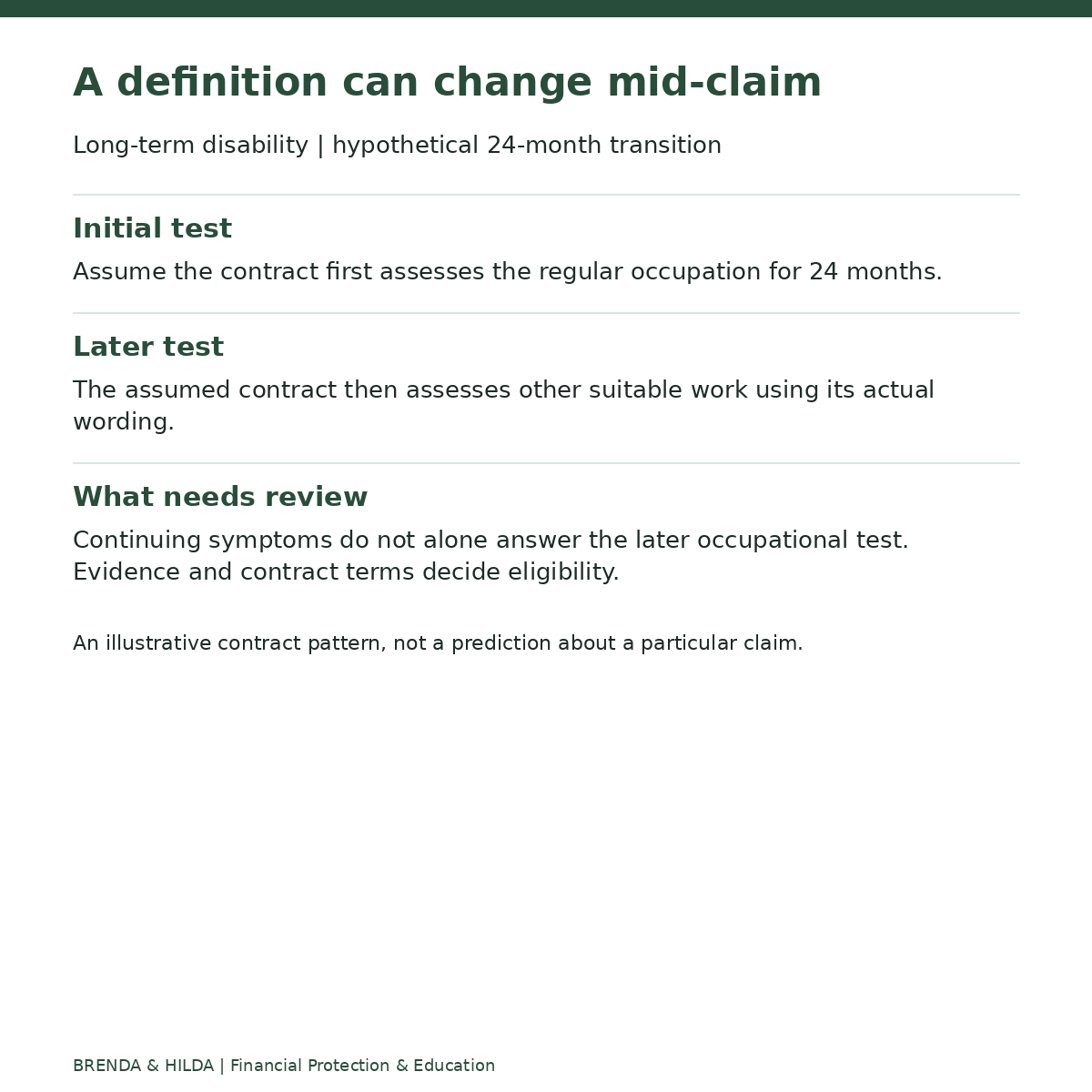
A long-term disability plan can change the test it applies while a person is still receiving treatment. Some plans initially assess the person’s ability to perform their regular occupation, then later assess whether they can perform another suitable occupation. Continued symptoms do not, on their own, answer the second question.[1]
The transition date and the actual wording belong beside the monthly benefit amount when reviewing coverage. They help explain why two plans advertising similar income replacement can respond differently to the same medical condition.
Which long-term disability definition applies?
Disability contracts can use own-occupation, regular-occupation and any-occupation definitions. Broadly, an own-occupation provision can permit benefits when the insured cannot perform their own occupational duties, even if they work in another occupation. A regular-occupation definition may stop or change benefits if the person chooses another occupation. An any-occupation test generally considers other work suited to the person’s education, training or experience.[1]
Those are descriptions, not substitute policy language. Group plans can use the label “own occupation” differently from an individual contract. Some definitions also contain an earnings threshold. An exclusion or rider can further restrict the conditions covered.
Hypothetical example: an employee’s hand injury prevents the duties of their usual job. Their assumed plan pays for 24 months under a regular-occupation test, then applies an any-suitable-occupation test. Medical evidence may support the initial claim. At the transition, the administrator also considers whether the employee can perform other suitable work under the contract’s criteria. A return to work, retraining or continued benefits would depend on the evidence and wording. This example does not predict a claim decision.
Is long-term disability permanent?
“Benefits to age 65” ordinarily describes a maximum duration, subject to continuing eligibility and the policy’s conditions. It does not promise that every approved claim will pay until that age. Recovery, a definition change, exclusions or other termination provisions may end payments earlier.[1]
The elimination period matters too. An individual policy with a 90-day wait and an employer plan with a different start date may leave an interval that needs funding. A claim-processing delay can add another cash-flow problem even when the eventual payment covers an earlier eligible period.
How do offsets affect long-term disability payments?
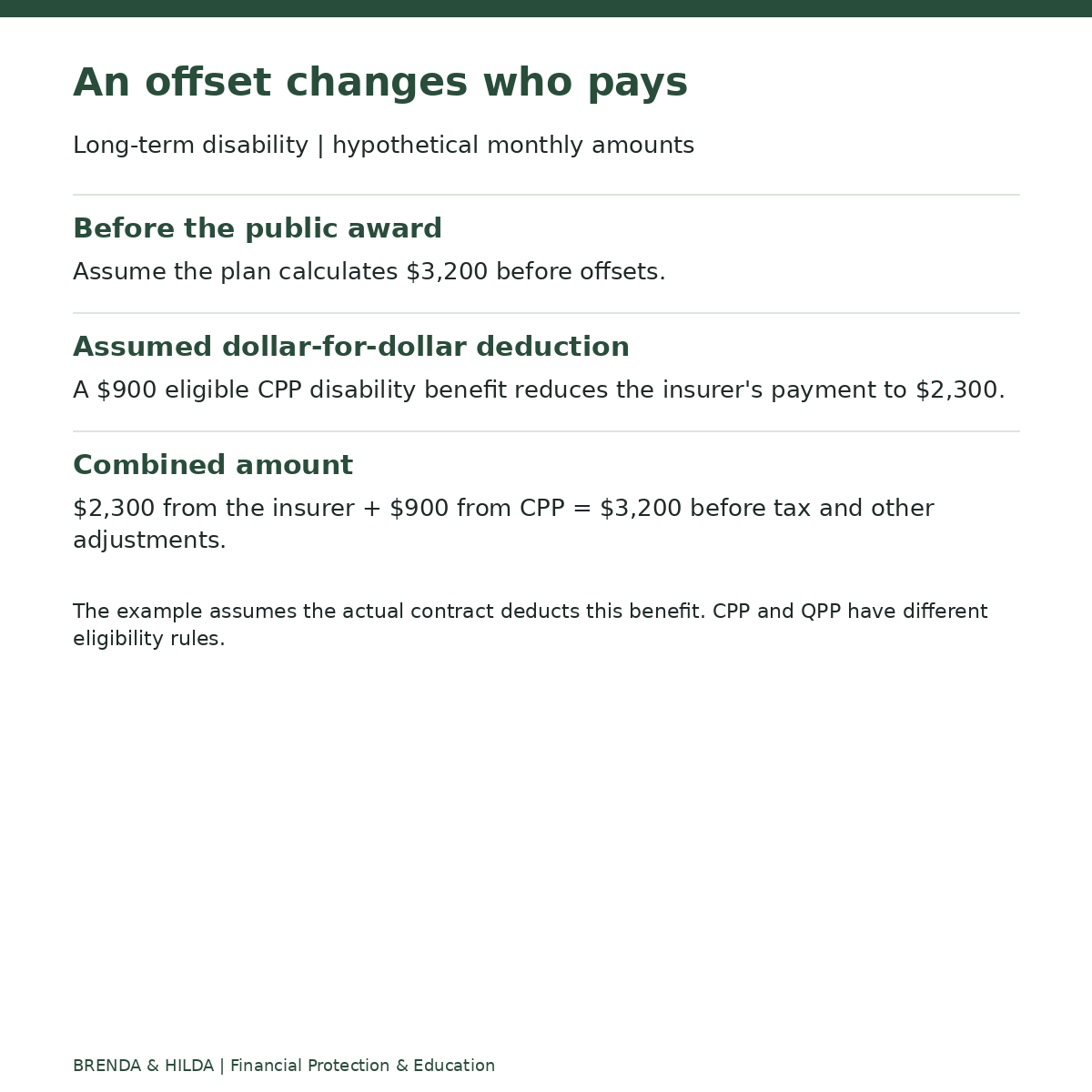
Group LTD plans often identify deductible sources of income, such as CPP disability benefits. A CPP award may replace part of the LTD payment instead of increasing total income by the full award. Retroactive government payments can produce a reimbursement obligation where the insurer has already paid benefits for the same period.[1]
Hypothetical example: a plan calculates a $3,200 monthly entitlement before offsets. Assume its terms deduct an eligible $900 CPP disability benefit dollar for dollar. The insurer then pays $2,300, with CPP paying $900. The total remains $3,200 before tax and any other adjustments. Actual plans can apply other limits or different treatment.
Partial-disability and rehabilitation provisions deserve attention before a return to work. They may allow some benefit while earnings recover, subject to a formula and reporting duties. Obtain the calculation before assuming that one day back at work ends every payment, or that work earnings can be added without adjustment.
Is long-term disability income taxable in Canada?
Generally, benefits are taxable when the employer pays all or part of the disability premiums. If the employee pays the entire premium, benefits are generally tax-free. Contribution history and the specific arrangement still matter, so a benefit percentage alone cannot tell you the spendable income. The plan administrator or payroll records can establish how the coverage was funded.[2]
Tax treatment is separate from an offset. A benefit can be reduced by other income under the contract and then be subject to tax. A budget built from the gross amount before both adjustments can overstate what is available for bills.
Keep a claim calendar
Record the elimination-period end, definition-change date, evidence deadlines and any appeal deadline in a decision letter. Ask the administrator to identify the exact clause behind a reduction or denial. Keep medical and occupational records through a secure channel. The website assessment is not the place to upload them.

CPP, QPP and workplace rules are not interchangeable
| Where the pension record and eligibility point | Public disability route |
|---|---|
| Quebec pension coverage | Retraite Québec’s QPP disability pension: its own contribution, medical and age-related conditions. Temporary disability is not covered. |
| Alberta, British Columbia, Manitoba, New Brunswick, Newfoundland and Labrador, Nova Scotia, Ontario, Prince Edward Island, Saskatchewan, Northwest Territories, Nunavut and Yukon | Service Canada’s CPP disability benefits: federal contribution and severe-and-prolonged disability requirements. A private LTD approval is not a CPP approval. |
A person who has worked in Quebec and elsewhere may have contributions under both plans. Contribution history and current circumstances determine which administration should receive the application. The two public pensions are not simply two additional monthly amounts to add to a private LTD entitlement.
Retraite Québec explains that an insurer may integrate QPP disability benefits and, in relevant age groups, retirement benefits. A retroactive award can produce an insurer reimbursement. The assumed CPP offset earlier is an illustration; a Quebec claim needs the QPP award and the actual policy wording. Official QPP integration explanation.
Employment leave, dismissal and accommodation questions require the applicable workplace law, separately from the insurer’s benefit decision. The official directory covers all 10 provinces and 3 territories and identifies federally regulated industries. Quebec payroll deductions also have their own Revenu Québec guidance.
The disability income sources article places employer benefits, public programs and savings on the same budget timeline.
Job-protected leave and disability payments answer different questions
The province or territory’s leave entitlement determines protected time away from work; a disability plan determines whether income is payable. Paid sick days, unpaid medical leave and private benefits may follow different eligibility and evidence rules. The province-by-province sick-leave comparison covers all 13 provinces and territories, with a separate federal-workplace row. Use the employment jurisdiction rather than assuming the rule follows the employee’s home address.
Where do you apply for long-term disability?
Start with the administrator identified in the benefit booklet or individual policy. An employer’s human-resources team may provide forms, but ask who receives the completed long-term disability application and who decides the claim. Obtain the employee, employer and medical sections early enough to understand their deadlines. Keep proof of submission and a copy of the documents through a secure channel. If a required item is delayed, contact the administrator for instructions rather than assuming an incomplete application preserves every deadline.
What should you record before a definition change?
Put the long-term disability definition-change date on a calendar alongside the date the insurer expects updated evidence. Write down the actual duties of the regular occupation, the restrictions affecting those duties and the wording used for other suitable work. For example, a job description listing physical tasks may raise different questions from one describing a largely seated role. This is preparation for the administrator’s review, not a way to decide your own eligibility. Ask which contractual clause and evidence the administrator will use at the transition.
Can long-term disability pay while you return part time?
The answer depends on the actual partial-disability or rehabilitation provision. Ask for a written illustration using the proposed hours and earnings before budgeting for a return to work. Record the assumed work income, the calculated insurance payment and any other deductions separately. A hypothetical $800 of wages cannot simply be added to the previous long-term disability payment without checking the contract’s calculation. Confirm how frequently earnings must be reported and how a later adjustment would be communicated. FCAC includes partial benefits among the questions to ask when reviewing disability coverage.[2]
What happens when an award is retroactive?
A payment covering earlier months may include money that replaces amounts already paid by a long-term disability insurer. Keep the award letter and the insurer’s calculation together. In the example above, assume the $900 public benefit covers six months for which the insurer already paid its unreduced $3,200. If the contract requires a matching dollar-for-dollar repayment for all six months, the illustrative amount is $5,400. That arithmetic does not establish the actual debt: effective dates, covered months, dependent benefits and other contract terms must be reconciled first. Avoid treating the entire deposit as new spending money before that reconciliation.
How do you review a reduction or denial?
Read the written long-term disability decision and identify the reason, policy clause, effective date and stated review deadline. Ask for clarification where a calculation or required document is unclear. Keep a dated record of correspondence and use the insurer’s designated complaint process where appropriate. A complaint route and a legal deadline are separate matters; sending a complaint does not establish that every other deadline stops. For help locating the applicable insurance authority, use the official regulator directory. Province-specific legal advice belongs with a qualified professional.
What belongs in a long-term disability budget review?
Bring the current booklet, any amendments, the benefit calculation and the next few months of ordinary bills. Separate confirmed net income from estimates. Add a timeline for the waiting period, any change in the disability definition and the maximum benefit duration. Mark missing information as unknown and assign someone to obtain it. The purpose is to see what the existing long-term disability arrangement actually provides before considering any change to coverage. A percentage on an employee-benefits summary cannot supply all of those answers.
Sources
[1] AMF, Disability insurance (salary insurance); FCAC, Disability insurance.
[2] FCAC, disability insurance, including questions about partial benefits, taxation and waiting periods.
About your advisor
Brenda Nkwocha and Hilda Chukwu are licensed life insurance advisors in Ontario. Personal recommendations and quotes follow a separate needs analysis. This article provides general education, not personalized advice, a quote or a guarantee.
Choose a starting point that fits your situation.
Answer a few questions about your existing arrangements and what to check. A summary is not a needs analysis or a recommendation.